
In November of 1915 Albert Einstein published the crowning conclusion of his General Theory of Relativity: a set of sixteen differential equations describing the gravitational field.2 Solutions to these equations are called metrics, because they show how distance-measuring and time-measuring devices (such as rulers and clocks) behave. The equations are so difficult to solve that new metrics, giving solutions under specific conditions, now appear only once every decade or so. Metrics are foundational; they open up new ways to understand space and time. For example, the first metric after Einstein’s work, found by Karl Schwarzschild in 1916,3not only explained the detailed orbits of planets, but also pointed to the possibility that ‘black holes’ might exist.
In the fall of 2007 I published a new metric as part of an explanation of the ‘Pioneer anomaly’, a decades-old mystery about the slowing-down of distant spacecraft.4 Compared to many modern metrics,5the new one is rather simple. It describes space and time inside an expanding spherical shell of mass. I was interested in that problem because of the ‘waters that are above the heavens’ that Psalm 148:4 mentions as still existing today above the highest stars (see figure 1). The waters would be moving outward along with the expansion of space mentioned in 17 Scripture passages.
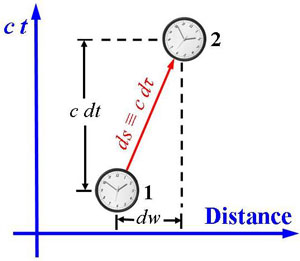
Figure 2. A moving clock measures the spacetime interval ds between two events.
According to data in my previous paper, the total mass of the shell of waters is greater than 8.8 × 1052 kg, more than 20 times the total mass of all the stars in all the galaxies the Hubble Space Telescope can observe.7 However, because the area of the shell is so great, more than 2 × 1053 m2, the average areal density of the shell is less than 0.5 kg/m2. By now the shell must have thinned out to a tenuous veil of ice particles, or perhaps broken up into planet-sized spheres of water with thick outer shells of ice. It is only the waters’ great total mass that has an effect on us, small but now measurable.
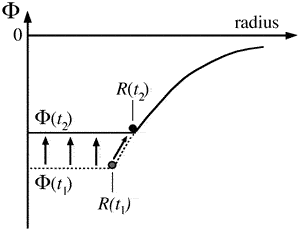
Figure 3. Gravitational potential F inside a spherical shell of mass increases as radius R of the shell increases between two events.
Because of the great mass of the ‘waters above’, I could neglect the smaller mass of all the galaxies in deriving the metric. Although other distributions of mass could also solve the Pioneer mystery, this one seems more applicable to biblical cosmology.
Being relatively simple, the new metric clarifies a new type of time dilation that was implicit in previous metrics but obscured by the effects of motion. This new type, which I call achronicity, or ‘timelessness’, affects not only the narrow volume of space at or just around an ‘event horizon’ (the critical radius around a black hole at which time stops), but all the volume within the horizon. Within an achronous region, we will see, time is completely stopped. I pointed out a related effect, ‘signature change,’ in an earlier paper,8 but all I had to go on then was an older metric, the Klein metric, which was quite complicated. The complexity obscured what that metric suggested could happen to time. The cosmology this paper outlines is a new one that does not stem from the Klein metric.

No comments:
Post a Comment