Powered By Blogger

Saturday, May 03, 2014

A TWIN PARADOX ????

In Einstein's special theory of relativity, there is no such thing as "time" in the singular. Time passes differently for different observers, depending on the observers' motion. The prime example is that of the two hypothetical twins: One of them stays at home, on Earth. The other journeys into space in an ultra-fast rocket, nearly as fast as the speed of light, before returning home:

Afterwards, when the twins are reunited on Earth, the travelling twin is markedly younger, compared to her stay-at-home sibling. The exact age difference depends on the details of the journey. For example, it could be that, aboard the space-ship, two years of flight-time have passed - on-board clocks and calendars show that two years have elapsed, and both spaceship and travelling twin have aged by exactly that amoung of time. On Earth, however, a whopping 30 years have passed between the spaceship's departure and its return. Just like all other humans on the planet, the twin on Earth has aged by 30 years during that time. Seeing the two (ex?) twins side by side, the difference is striking.
So far, so strange, but undoubtedly real. Space-travel with speeds close to that of light may be unfathomably far beyond the reach of current technology. But sending elementary particles on round trips in a particle accelerator at 99.99999 percent of light speed is routine. The result is in precise agreement with the predictions of special relativity - the "inner clock" of such a travelling particle runs much slower than that of a particle of the same species that remains at rest (cf. the page The relativity of space and time in the section Special Relativity ofElementary Einstein).

The reason the case of the travelling twins is also known as the "twin problem" or even the "twin paradox" is the following. From the point of view of the twin on Earth, one can explain the age difference by appealing to time dilation, a basic concept of special relativity. It involves an observer (more precisely: an inertial observer), for instance an observer that lives on a space station floating through empty space. For such an observer, special relativity predicts the following: For any moving clock, that observer will come to the conclusion that it is running slower than his own. Whether it is a clock on another space station floating past or a clock on an engine-driven rocket, in the time it takes for a second to elapse on the observer's own clocks, less than a second will have elapsed on the moving clock. This slowdown is true not only for clocks, but for everything that happens on the moving space station or in the flying rocket. All processes taking place on these moving objects will appear slowed down for our observer.
Characteristically, there are situations where time dilation is mutual. For instance, if there are two observers drifting through space, each on his or her own space station, and if those two space stations are in relative motion, then for each observer, the time in the other space station appears to run slower than for himself. (If that already sounds like a paradox to you, you might want to read the spotlight topic The dialectic of relativity.)
With the help of time dilation - often abbreviated to "moving clocks go slower" - one can try to explain what happens to the twins. No wonder the travelling twin ages less! After all, the twin on Earth can invoke time dilation: Moving clocks go slower, and so do the clocks of the moving twin. On these slower-moving clocks - and, by extension, in the whole spaceship - less time passes than on Earth, in other words: when the travelling twin returns, he is younger.
No paradox so far. But why can't the travelling twin turn the tables on her sibling? After all, motion is relative. Why can't the twin in the spaceship define herself as being at rest? From that point of view, it would be the Earth that moves away before returning to the spaceship. And if that is so, couldn't the travelling twin apply time dilation ("moving clocks are slower") to everyone who remained on Earth? By that argument, shouldn't it be the humans on Earth that are younger than expected once the twins are reunited? If both twins are on an equal footing, then each one should be allowed to onsider herself at rest and invoke time dilation. But in the end, when the twins meet again, only one of them can be right - then, there cannot be any ambiguity: either the one twin is younger, or the other (or, of course, both twins' arguments are wrong, and they have aged exactly the same). A contradiction - a twin paradox?

A PROOF OF PARTICLES TRAVELLING FASTER THAN SPEED OF LIGHT ....

According to a report by the Associated Press, researchers at CERN have observed a subatomic particle moving faster than the speed of light. That’s right, faster than the speed of light. Like any sane people, these researchers are currently looking for outside sources to verify their results, and with results as mind-boggling as these, who could blame them.
It appears that the actual observation happened several months ago when a neutrino beam was shot 454 miles from the area around Geneva to Italy and arrived 60 nanoseconds earlier than light would. That’s not much over, but the margin of error was only 10 nanoseconds, which means this is a statistically significant discovery. After pouring over the results for months, CERN has now turned to the U.S. and Japan to double check their work. Although a 50 to 70 nanosecond gain over the course of 454 miles might not sound like much, it could actually change the understanding of physics as we know it, or at least as we’ve known in the past century.
According to Einstein’s theory of relativity, which has held up well so far, no particle with mass should be able to accelerate to speeds faster than the speed of light without requiring infinite energy. This one instance may be enough to completely change the way we think the world might work. While special relativity does not exactly prohibit particles the travel faster than the speed of light (see tachyons, theoretical particles that are always moving faster than the speed of light), this instance of a particle being accelerated beyond it is revolutionary because no one has ever actually observed this happening before.
It’s easy to jump off the rails thinking about the possibilities of faster-than-light travel, but everyone is keeping in mind that this might be an error of some sort. Even if it turns out to be completely true, not much happens, other than the theory of relativity as we know needing some reevaluation. It was only neutrinos, and only a 50 to 70 nanosecond gain, but still, it may turn out that the speed of light is an arbitrary limit, which opens up an incredible world of opportunities. After all, particles that move faster than light should be able to go forwards or backwards in time.

Friday, May 02, 2014

PARTICLES THAT TRAVEL FASTER THAN LIGHT ....


European Physicists claim to have detected neutrinos (small sub-atomic particles), travelling at faster than the speed of light.  Researchers on the OPERA, (Oscillation Project with Emulsion-Tracking Apparatus), experiment blasted a beam producing billions upon billions of neutrinos from CERN, which straddles the French-Swiss border near Geneva, to the Gran Sasso Laboratory 450 miles away in Italy.  The particles appear to have been clocked at an astounding 186,415.086 miles per second.  A feat currently forbidden by Einstein’s theory of special relativity, a theory that is a foundation of physics.  The speed of light at 186,282 miles per second is considered the cosmic speed limit.
OPERA’s claim is being greeted with skepticism inside and outside the European lab.  “The feeling that most people have is this can’t be right, this can’t be real,” said James Gillies, a spokesman for CERN.  Alvaro de Rujula, a theoretical physicist who works at CERN, called the claim “flabbergasting.”   “If it is true, then we truly haven’t understood anything about anything,” he said, adding: “It looks too big to be true.  The correct attitude is to ask oneself what went wrong.”
Antonio Ereditato, the physicist who leads OPERA, made it clear that while the team had looked hard for any measurement errors or other mistakes that could explain it, and found none, the results still needed careful checking: “After many months of studies and cross checks we have not found any instrumental effect that could explain the result of the measurement.  While OPERA researchers will continue their studies, we are also looking forward to independent measurements to fully assess the nature of this observation.”
John Learned, a neutrino astronomer at the University of Hawaii, said that if the results of the OPERA researchers turned out to be true, it could be the first hint that neutrinos can take a shortcut through space, through extra dimensions.  Joe Lykken of Fermilab said, “Special relativity only holds in flat space, so if there is a warped fifth dimension, it is possible that on other slices of it, the speed of light is different.”
The results were announced at a special seminar at CERN today, which coincided with the publication of a research paper describing the experiments.  The Gran Sasso National Laboratory, the world’s largest underground particle physics Laboratory is located under a mountain in central Italy.  The CERN, (European Center for Nuclear Research), complex operates a network of six accelerators and a decelerator including the worlds largest particle accelerator the Large Hadron Collider or LHC.
Neutrinos are electrically neutral particles so small that only recently were they found to have mass.

Thursday, May 01, 2014

NASA : WRAP DRIVE EXPERIMENT ....

As we take our virgin steps into space, there is one thing that could always put a cap on our ambitions.
Despite our desire to explore the stars, we are limited by travelling at less than light speed - and even if we managed to match that pace, we would still be listing our voyages from star to star in years, centuries or millenia.
But, in what could be a huge breakthrough, theorists from Nasa say there is 'hope' that we can achieve faster-than-light travel, after physicists found a theoretical possibility for warp speed travel.


But according to Space.com, Harold 'Sonny' White, from NASA's Johnson Space Center, told the 100 Year Starship Symposium, a gathering of scientists, writers and philosophers in Houston, that new theories could allow Man to reach such speeds with less energy.
He told his audience that, instead of enclosing a space-ship in a space time-bubble, a craft could sit within a 'doughnut' shape - which means the warp drive could be powered by a mass the size of a spacecraft like the Voyager 1 probe - the equivalent size of a small car.
He told Space.com: ''The findings I presented today change it from impractical to plausible and worth further investigation.
'The additional energy reduction realized by oscillating the bubble intensity is an interesting conjecture that we will enjoy looking at in the lab.'
White and his team are experimenting with a mini-version of a warp drive in their laboratory, using laser to try to warp space and time in miniature.
He said his 'humble experiment' was 'trying to see if we can generate a very tiny instance of this in a tabletop experiment, to try to perturb space-time by one part in 10 million.'

Wednesday, April 30, 2014

SEEING THROUGH TIME .....


This is not an assumption. This is a scientific fact. We are able to see the past through looking at the stars. The light from the distant stars takes a lot of light years to reach the Earth. Hence when we are looking at the beautiful starry sky in a clear night we are actually looking at the past of these stars. Astonishingly enough we are looking at a lot of different pasts simultaneously, as these stars are vastly different in regard to their distance from us

There are many conceivable ways of time travel, and many people who do and do not believe in them (such beliefs do not in fact change any laws of nature).
If time travel were assumed to be possible then many impossibilities would be assumed to appear. For example, if someone were to travel into the past and see himself as a child he could kill himself. Okay, so that would be a pretty dumb thing to do, but the possibility brings up a paradox. If he kills himself, then he could never go back in time and kill himself. The possibility of this situation might lead to believe that time travel into the past is not possible. In fact the only time a paradox could be assumed to happen is when someone travels backward in time, and if this travel proves to be possible it should eliminate the possibility of a paradox (by definition paradoxes never happen). In the above example the man would not be able to kill himself, no matter hard he tried, because he has already got to live into the future without killing himself. Someone who does not agree?

Isaac Newton's ideas were widely accepted and could be accurately applied to most of the universal calculations. It wasn't until a slight discrepancy in the observed Mercury orbit and the calculated one that scientists began to wonder if Isaac Newton was entirely correct. The Mercury orbit differed by exactly 42 arc seconds. Later when it was found that light always appeared to move with the same speed despite one's own velocity, combined with many other observations, the Newtonian universe began to crumble.
It was time for new ideas. Albert Einstein was full of them. His theory of relativity assumed that time was the fourth dimension, he introduced the concept of Space-Time. A large mass would bend the space around it and in doing so would create gravity (a Time-Space cartoon). This was a far fetch from original theories, but it predicted the Mercury orbit exactly. Later it was given further support by a test during an eclipse. The light from a star was bent as it came into the curved space created by the sun.
The time travel aspect of this comes from the curved space. When a mass bends the Space-Time it makes distances longer, it stretches the space. A spaceship traveling into the gravity of a large mass, a star, for example Sirus, going 100,000 miles per hour would look like it was traveling quite fast to someone outside the spaceship. Once the ship enters the gravity of Sirus, the ship would seem to slow down. It hasn't though, ship's computer states a constant velocity of 100,000 miles per hour. The person outside is watching the ship and the ship seems to stopp. The space around Sirus which appears to be an inch is actually, once you get there, 100,000 miles. The man inside the ship feels no differens and he continues to travel what seems to be 100,000 miles per hour, so his time must have slowed down. His hour becomes longer than it is to the observer. His clock still runs in a steady motion but it moves slower in comparison to the clock of the observer. This is called Time Dilation. In fact according to the theory of relativity, by moving at speeds close to the speed of the light, even if this happens in a train, the clock would slow down (in relation to the clock of an observer), and one could in this way travel forward in time.

Monday, April 28, 2014

Ronald Mallett, Professor at the University of Connecticut, has used Einstein’s equations to design a time machine with circulating laser beams. While his team is still looking for funding, he hopes to build and test the device in the next 10 years.

With a brilliant idea and equations based on Einstein’s relativity theories, Ronald Mallett from the University of Connecticut has devised an experiment to observe a time traveling neutron in a circulating light beam. While his team still needs funding for the project, Mallett calculates that the possibility of time travel using this method could be verified within a decade.

“Einstein showed that mass and energy are the same thing,” said Mallett, who published his first research on time travel in 2000 in Physics Letters. “The time machine we’ve designed uses light in the form of circulating lasers to warp or loop time instead of using massive objects.” 
And according to Einstein, whenever you do something to space, you also affect time. Twisting space causes time to be twisted, meaning you could theoretically walk through time as you walk through space.
“As physicists, our experiments deal with subatomic particles,” said Mallett. “How soon humans will be able to time travel depends largely on the success of these experiments, which will take the better part of a decade. And depending on breakthroughs, technology, and funding, I believe that human time travel could happen this century.”
Step back a minute (sorry, only figuratively). How do we know that time is not merely a human invention, and that manipulating it just doesn’t make sense?
“What is time? That is a very, very difficult question,” said Mallett. “Time is a way of separating events from each other. Even without thinking about time, we can see that things change, seasons change, people change. The fact that the world changes is an intrinsic feature of the physical world, and time is independent of whether or not we have a name for it.
“To physicists, time is what’s measured by clocks. Using this definition, we can manipulate time by changing the rate of clocks, which changes the rate at which events occur. Einstein showed that time is affected by motion, and his theories have been demonstrated experimentally by comparing time on an atomic clock that has traveled around the earth on a jet. It’s slower than a clock on earth.”
Although the jet-flying clock regained its normal pace when it landed, it never caught up with earth clocks - which means that we have a time traveler from the past among us already, even though it thinks it’s in the future.
Some people show concern over time traveling, although Mallett - an advocate of the Parallel Universes theory - assures us that time machines will not present any danger.
“The Grandfather Paradox [where you go back in time and kill your grandfather] is not an issue,” said Mallett. “In a sense, time travel means that you’re traveling both in time and into other universes. If you go back into the past, you’ll go into another universe. As soon as you arrive at the past, you’re making a choice and there’ll be a split. Our universe will not be affected by what you do in your visit to the past.”
In light of this causal “safety,” it’s kind of ironic that what prompted Mallett as a child to investigate time travel was a desire to change the past in hopes of a different future. When he was 10 years old, his father died of a heart attack at age 33. After reading The Time Machine by H.G. Wells, Mallett was determined to find a way to go back and warn his father about the dangers of smoking.
This personal element fueled Mallett’s perseverance to study science, master Einstein’s equations, and build a professional career with many high notes. Since the ‘70s, his research has included quantum gravity, relativistic cosmology and gauge theories, and he plans to publish a popular science/memoir book this November 2006. With help from Bruce Henderson, the New York Times best-selling author, the book will be called Time Traveler: A Physicist’s Quest For The Ultimate Breakthrough.

THE COSMIC SUPER STRINGS' THEORY ....


Under normal circumstances, the effects of time dilation are negligible. You aren’t going to find yourself in the 23rd century just by running extra fast. But, when objects (or, theoretically, people) move at what Greene terms “a significant fraction of light speed,” time dilation is very pronounced.

Yet another theory for how we might travel back and forth through time uses the idea of cosmic strings, proposed by Princeton physicist J. Richard Gott in 1991. These are - as their name suggests - string-like objects that some scientists believe were formed in the early universe. These strings may line the entire length of the universe and are under immense pressure - millions upon millions of tons.


These cosmic strings, which are thinner than an atom, would generate an enormous amount of gravitational pull on any objects that pass near them.


Objects attached to a cosmic string could travel at incredible speeds, and because their gravitational force distorts spacetime, they could be used for time travel. By pulling two cosmic strings close together, or one string close to a black hole, it might be possible to warp spacetime enough to create closed time-like curves. 


A spacecraft could be turned into a time machine by using the gravity produced by the two cosmic strings, or the string and black hole, to propel itself into the past. To do this, it would loop around the cosmic strings. However, there is still much speculation as to whether these strings exist, and if they do, in what form. Gott himself said that in order to travel back in time even one year, it would take a loop of string that contained half the mass-energy of an entire galaxy.


Cosmic superstring loops wiggle and oscillate, producing gravitational waves, then slowly shrink as they lose energy until they disappear.

Cosmic strings are theoretical fault lines in the universe, defective links between different regions of space created in the moments after the Big Bang. And they might be theoretical no longer - distant quasars show the fingerprints of these strings.
Compared to cosmic strings, black holes seem downright sensible. These strings - no relation to the subatomic strings of theoretical physics - are one-dimensional objects, meaning they have length, but no height or width. They are defects in the fabric of the universe, a byproduct of the universe cooling in the first instants after the Big Bang. The easiest way to think about these strings is to see them as the cosmic equivalent of the cracks that form in ice over a frozen lake.
Of course, that doesn't capture the full measure of their one-dimensional weirdness. Since they have no width or height, they are incomprehensibly narrow, with a diameter that would make even a tiny photon look fat. They're also dense, as a string that's even a mile long would weigh considerably more than Earth. These strings expanded right along with the universe, ultimately stretching across the entire known universe in a more or less straight line, or forming massive rings many thousands of times bigger than our galaxy.
We've not yet directly observed these strings, but researchers at the University of Buffalo say they've found clear indirect proof. They studied 355 quasars - incredibly bright galaxies with super-massive black holes at their center - at the furthest corners of the observable universe. All quasars emit massive energy jets pointed in a particular direction, and through very careful study it's possible to figure out the directions of the jets.
183 of those quasar jets lined up to form a pair of enormous rings in the sky, suggesting two massive circular structures exist - or had existed - to orient the direction of the jets. The only known candidates for such colossal structures are cosmic strings, providing compelling indirect evidence for them. If we confirm the existence of cosmic strings, it will greatly improve our understanding of the formation of the earliest galaxies.
This isn't clinching proof - some scientists, like Arizona State's Tanmay Vachaspati, are skeptical cosmic strings that formed nanoseconds after the Big Bang could last long enough after the Big Bang to affect quasars in this way.

Saturday, April 26, 2014

RATE OF TIME DILATION ...

When a ship approaches to within 90% of the speed of light, time slows down. Characters on board the ship would not notice, but if they were to make hourly reports back to their point of origin, those reports might arrive only once every hundred hours.
This creates an interesting paradox, in that if a character managed to travel at the speed of light to another star and back again, a newborn child he left behind would now be older than him—if the child hadn’t died of old age some time ago.
The actual amount of time dilation observed aboard a ship traveling near light speed increases in proportion to just how close it is to light speed. Technically, time dilation occurs at any speed, but it only becomes noticeable at relativistic speeds. The dilation is a ratio that determines how much time passes aboard the ship; it is a multiplier when determining how much time passes outside the ship.
For example, a ship moving at 70% the speed of light has a time dilation of 1.4. Ten hours of travel aboard the ship at this speed means that 14 hours (10 × 1.4) have passed outside the ship. However, if ten hours pass for those left behind, only 7.1 hours have passed aboard the ship (10 divided by 1.4).
Table: Time Dilation
Starship Speed (miles/second)AU per hour% Speed of LightTime Dilation
2,0460.181.1%1.0003
26,0401.014%1.01
52,0802.028%1.04
78,1203.042%1.1
104,1604.056%1.2
130,2005.070%1.4
154,3806.083%1.8
167,4006.590%2.3
180,4207.097%3.9
182,4667.198.1%5.1
185,9817.23999.99%60.2
Starship Speed: The vessel’s speed in miles per second.
AU per Hour: How many Astronomical Units (AU) a vessel traveling at this speed can cross in 1 hour. One AU equals 93,000,000 miles (the distance between the Sun and the Earth).
% Speed of Light: The percentage of the speed of light (186,000 miles per second).
Time Dilation: Divide the time traveled by this number to arrive at the amount of time that passes on board the starship.

TIME CONTROLLED BY SPEED OF LIGHT ...


Thus in regions of space that are below the critical potential, light cannot propagate. This (as well as many other relativistic effects) suggests a deep connection between the coordinate speed of light and the flow of time.
This is a diagram of one of the simplest clocks I can imagine, a light pulse bouncing between two mirrors. In a timeless region with no motion of photons, this clock would stop. Simple mechanical clocks depend on c the same way. The speed of light appears to affect all physical processes we understand in the same way. For example, in the relativistic generalization of classical electrodynamics, electric and magnetic forces are proportional to the coordinate speed of light. thus becoming zero or imaginary when the speed becomes zero or imaginary. Or, if you prefer the quantum-mechanical description of electromagnetic forces, particles in an achronous region could not exchange ‘virtual’ photons (the photons being unable to propagate), so they could not interact. No interaction and no forces mean no physical processes and no activity—no time. Thus the coordinate speed of light controls time.

THE TIME DILATION THEORY .....

In November of 1915 Albert Einstein published the crowning conclusion of his General Theory of Relativity: a set of sixteen differential equations describing the gravitational field.2 Solutions to these equations are called metrics, because they show how distance-measuring and time-measuring devices (such as rulers and clocks) behave. The equations are so difficult to solve that new metrics, giving solutions under specific conditions, now appear only once every decade or so. Metrics are foundational; they open up new ways to understand space and time. For example, the first metric after Einstein’s work, found by Karl Schwarzschild in 1916,3not only explained the detailed orbits of planets, but also pointed to the possibility that ‘black holes’ might exist.
In the fall of 2007 I published a new metric as part of an explanation of the ‘Pioneer anomaly’, a decades-old mystery about the slowing-down of distant spacecraft.4 Compared to many modern metrics,5the new one is rather simple. It describes space and time inside an expanding spherical shell of mass. I was interested in that problem because of the ‘waters that are above the heavens’ that Psalm 148:4 mentions as still existing today above the highest stars (see figure 1). The waters would be moving outward along with the expansion of space mentioned in 17 Scripture passages.
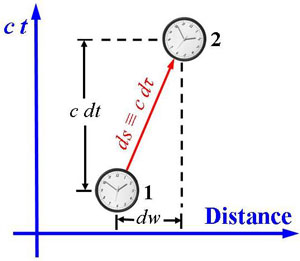
A moving clock measures the spacetime interval ds between two events.
Figure 2. A moving clock measures the spacetime interval ds between two events.
According to data in my previous paper, the total mass of the shell of waters is greater than 8.8 × 1052 kg, more than 20 times the total mass of all the stars in all the galaxies the Hubble Space Telescope can observe.7 However, because the area of the shell is so great, more than 2 × 1053 m2, the average areal density of the shell is less than 0.5 kg/m2. By now the shell must have thinned out to a tenuous veil of ice particles, or perhaps broken up into planet-sized spheres of water with thick outer shells of ice. It is only the waters’ great total mass that has an effect on us, small but now measurable.
A moving clock measures the spacetime interval ds between two events.
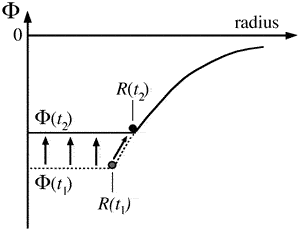
Figure 3. Gravitational potential F inside a spherical shell of mass increases as radius R of the shell increases between two events.
Because of the great mass of the ‘waters above’, I could neglect the smaller mass of all the galaxies in deriving the metric. Although other distributions of mass could also solve the Pioneer mystery, this one seems more applicable to biblical cosmology.
Being relatively simple, the new metric clarifies a new type of time dilation that was implicit in previous metrics but obscured by the effects of motion. This new type, which I call achronicity, or ‘timelessness’, affects not only the narrow volume of space at or just around an ‘event horizon’ (the critical radius around a black hole at which time stops), but all the volume within the horizon. Within an achronous region, we will see, time is completely stopped. I pointed out a related effect, ‘signature change,’ in an earlier paper,8 but all I had to go on then was an older metric, the Klein metric, which was quite complicated. The complexity obscured what that metric suggested could happen to time. The cosmology this paper outlines is a new one that does not stem from the Klein metric.

AN EVIDENCE TO SHOW TIME DILATION IS POSSIBLE ....


There are other ways, however, to put his ideas to the test. How do we know Einstein had it right? One experiment in the 1970s provided some pretty strong evidence:
Atomic clocks are extremely accurate clocks that can measure tiny amounts of time—billionths of a second. In 1971, scientists used these clocks to test Einstein's ideas. One atomic clock was set up on the ground, while another was sent around the world on a jet traveling at 600 mph. At the start, both clocks showed exactly the same time.
What happened when the clock flown around the world returned to the spot where the other clock was? As Einstein had predicted in a general way, the clocks no longer showed the same time—the clock on the jet was behind by a few billionths of a second. Why such a small difference? Well, 600 mph is fast but still just the tiniest fraction of the speed of light. To see any significant differences in time, you'd have to be traveling many millions of miles an hour faster. 

One of the issues that concern many people who wish to adopt young-earth creationism as a valid view of earth history is the question of how stars can be seen many millions of light years away if only a few thousand years have passed since they were created. Dr. Russell Humphreys, a previous researcher at ICR, spent years working on this problem and has developed a creationist cosmology that seems to resolve this question.
On the fourth day of creation, how long did it take God to make the stars and bring their light to earth? No time at all, according to clocks here on earth. That is what Humphreys concludes from his new creationist cosmology research. The cosmology presented in his 1994 book, Starlight and Time,1 had the light getting to earth in a finite amount of time, not instantaneously. The general features of that cosmology—a universe centered upon our galaxy, expansion of space, and gravitational time dilation—still appear to be correct. But Humphreys was never fully satisfied with its details because a) the solution did not provide enough time dilation for nearby stars and galaxies, and b) it was based on a metric—a solution of Einstein’s gravity equations—that was too complex to analyze fully.

A referee for a subsequent relativity paper Humphreys wrote insisted that he derive a new metric to support the paper’s conclusions. After several months of mathematical work, Humphreys found the solution and the Journal of Creation published his results.2The article’s appendix contains the new metric and derivation. In a series of Acts & Facts articles, we will describe qualitatively the implications of this new metric and how it explains the cosmology of the creation events.
The new metric is not complicated, compared to many modern ones. Because it is simple and yet rigorous, it shows a feature of gravitational time dilation that nobody had noticed before. The feature was implicit in many previous metrics, but it had been obscured by the effects of motion. Humphreys calls this feature of time dilation achronicity, or “timelessness.” It causes clocks and all physical processes—hence, time itself—to be completely stopped in a region that could be very large. This is in contrast to the time dilation around a black hole, in which time is completely stopped only at a certain exact distance from its center, at the “event horizon.”3 In his 2008 article, Humphreys showed how this new metric led straightforwardly to achronicity. In the last five pages of the paper, he applied the time dilation achronicity to develop a new creationist cosmology.

Thursday, April 24, 2014

TIME DILATION cont'd .....


We talked about time dilation being caused by things moving a different speeds relative to each other. However, there is also another form of time dilation that we didn't get to – gravitational time dilation. Albert Einstein came up with this too, this time in his general theory of relativity (which came after the special theory). In this work he shows that if a clock is placed near to an object with very strong gravity then that also slows down time. Move further away from the massive object and time speeds up (relative to before, of course).


Because astronauts and satellites orbiting the Earth are slightly further away from the centre of the planet (compared to people on the ground) they actually experience less gravitational time dilation. On its own this would mean astronauts' time would run faster. However, this effect is quite small because Earth's gravity is quite weak and so the time dilation due to their speed wins out and astronauts really do travel a tiny amount into their futures.
Time travel to the past
We only had time to talk about time travel to the future – which, as we've seen, has already been achieved. However, time travel to the past would also be a popular option. Imagine instead of learning about Henry VIII, JFK and Michelangelo in a classroom, you could travel to Tudor England, the White House of the 1960s, or the Sistine Chapel during its painting and experience it first hand!
Scientists love to argue about whether time travel to the past is possible. The short answer is that it probably isn't. In any case it is a lot harder than going forwards in time. Some physicists have concocted an elaborate way that might one day achieve it, however. Their scheme uses a hypothetical tunnel in space called a wormhole, that is turned into a time machine by using the effects of time dilation. But, there is a catch. Time traveling this way, it is impossible to go back to a time before you have built the time machine. Having not built it yet, you couldn't go back to before today.
Such a machine also throws up some rather thorny questions. Firstly, the moment you build your time machine you might end up inundated with visitors. This is because once it has been built it exists at all future times (unless someone subsequently destroys it). So someone from the future might use it to go back to meet the person who first built it. You probably wouldn't get a chance to use the machine yourself as you'd be so busy meeting people who will use it in the future!
There are also problems with paradoxes. Say a time machine that can take you to the past is one day invented. 100 years after it is invented, a time traveler uses it to go back in time and then shoots his grandfather when he was a teenager. Now dead, his grandfather cannot grow up to marry his grandmother and have his father. If his father was never born, then how was he born? How can someone who was never born travel back in time and shoot someone? These problems are used by some physicists to argue that time travel to the past is therefore impossible.
If you're interested in some of these questions then there are plenty of books out there to read. I have written a book myself called “The Big Questions in Science: The Quest to Solve The Great Unknowns”. The final chapter is called “Is time travel possible?” and looks at both forms of time dilation, as well as how to build a time machine to the past using the wormhole technique.


TIME DILATION AND SPEED OF LIGHT ....

Time and the speed of light are probably the two subjects in astronomy (besides quantum mechanics) that most people have a hard time understanding. I think on these two, it’s because they are very hard to visualize and understand at first. They’re not something you can easily close your eyes and picture in your mind. Hopefully we can change that now and by the end of this read you will have a better understanding of these two topics. They seem hard but like anything new, once you “get it” or start to understand it, you’ll wonder why you thought it was so hard to understand. Even though we experience both every day, time and the speed of light usually happens without us noticing or thinking about them.
So let us begin with the speed of light first if for the only reason, I just like thinking about it.
Knowing the speed of light helps us in determining the age of the universe as well as understanding the great, great distances to the stars and the galaxies in the universe. Light also, using telescopes, lets us see into the distance past and shows us what the universe looked liked billions of years ago. Yes, using light we can actually see the universe billions of years ago. light can be a time machine into the distant past.
So what is the speed of light and how fast is it? Well, lets say I have a flashlight that was the most powerful flashlight ever made and it was bright enough so that its light over time could travel through the universe. Even though according to Albert Einstein and others, traveling at the speed of light is impossible for anything with mass, let’s say we could somehow strap you onto a photon of light as it leaves the flashlight and you can hang on as it starts its journey through the universe. Now, when we talk about how fast photons of light move, there is probably nothing faster than light. Now, when I turn the flashlight on you had better hang on because in one second you will travel 186,000 miles . In one second, light travels over three quarters the distance to the moon, which is 238.900 miles away from the Earth.
To understand the distance to our moon, the Earth is 7926 miles in diameter and our moon is 238,900 away from the Earth. If we took 30 Earth’s and put them side by side, that would be how far away the moon is from us. So we now know that light travels at 186,000 miles per second and that is a distance of more than three quarters the way to the Moon. That is what is called a “light second.” The distance light travels in one second is 186,000 miles. Also in one second, light will make 60 trips between New York and Los Angeles. Being mass less, photons of light are possibly the fastest things in the universe and nothing can travel faster than light. You could not travel faster than light because if you could you would be in a time that has not yet happened. You would be ahead of time and you can’t be in a time that has not yet occurred and you would begin traveling backwards in time.
It’s a long way to travel in one second but now we’re going to go to much greater distances. After one minute hanging onto that photon of light, you will have traveled 11,160,000 miles. That’s over eleven million miles and is called a “light minute”. If you could hang on for one hour you will have traveled 669,600,000 miles, almost seven hundred million miles and a light hour. If you could hold on for a full day, 24 hours, you will have traveled             16,070,400,000 miles. That’s over sixteen billion miles. I’m not sure they call this anything but we’ll call it a light day.
Even further away is the famous “light year,” the distance light travels in one year. I’ll repeat that just in case you have to re-look at the last line. A light year is the distance light travels in one year. That distance is                       5,900,000,000,000 miles. That’s right, five trillion, nine hundred billion miles that light travels in one year. It is often rounded up to 6 trillion miles in a year or that a light year equals a distance of 6 trillion miles. What’s a hundred billion when your talking about almost 6 trillion?
A light year, a light hour and a light minute are all measurements of distance rather than time although time is an equation within this distance which I will get into a little farther into this chapter.
Now when we determine the distances to the stars within our galaxy or even further to the 300 billion other galaxies in the Universe, we are talking about distances that are very, very hard to visualize and comprehend. Even trying to picture the distance to the closest star to us, Alpha Centuari, which is 4.5 light years distance from us is hard to visualize when you think that 4.5 light years is almost 25 trillion miles away from us and we kind of go, huh? Saying 26 trillion miles is not something that is easily visualized. And if we can’t visualize 25 trillion miles, how can we possibly visualize a galaxy that is 13 billion light years away. How can anyone understand these distances when you remember that one light year equals a distance of almost 6 trillion miles and you want to understand what 13 billion individual light years distance is. If you’d like to figure out the mileage, that would be 13,000,000,000 times (x) 6,000,000,000,000 (13 billion x 6 trillion). All we can ever accept or understand of a number this large is that it’s a number with a lot of zero’s. As far as how far in miles that is, yea right. It just makes it easier to understand when you hear 13 billion light years compared to eighteen million kazillion, seven hundred forty three quintillion, nine hundred million quadrillion, eighty eight trillion, four million billion, fifty nine million, thirty three thousand, six hundred and eighty eight miles away. That’s not easy to understand or say and that’s why we use light years as a measurement. We also use other measurements for larger distances such as “parsecs” which equals a distance of 3.26 light years but we’ll save those for another time and use light years here.
Now the really cool thing about looking at stars and galaxies and how many light years away they are is where “time” comes in.  Time is a weird thing when it comes to the speed of light because with the speed of light, the farther something is away from us, the more time it took those photons of light traveling through the universe to reach us for us to see.  The farthest galaxies we can see today, we see them after they have traveled the universe  for the last 13.2 billion years (13 billion, 200 million).  As these photons arrive for us to see, they carry with them a picture of their place of origin.  In essence, the further light has traveled to us, the further back in time we are seeing. When we look at these 13 billion light year distant galaxies, we are seeing the light that left these galaxies 13.2 billion years ago. What we see is how these galaxies looked 13.2 billion ago, about 500 to 700 million years after the Big bang.  To see where these galaxies are today, we’d have to wait about 45 billion years because today those galaxies are about that far away from us as for the last 13.2 billion years, these galaxies have been expanding with space away from us.  telescopes.  The only time machines around today are telescopes that let us see deep into the universe’s past. 
We can actually see into the past like a time machine by looking farther and farther into the Universe. As we started out in the beginning of this chapter, when I turn the flashlight on and you hang on to that photon of light, that photon takes off and begins its journey through the Universe at a speed of 186 thousand miles a second and 6 trillion miles a year. When we look at a galaxy 13 billion light years away from us, that photon has traveled 13 billion years at the speed of 6 trillion miles a year to reach our telescope and our eyes. The same is true when we look at a star such as Sirius, a bright star located only 8 light years away or 8 x 6 trillion miles, so its light has traveled 48 trillion miles, taking 8 years to reach us. As we look at Sirius, we are seeing it as it looked 8 years ago as it took these photons of light 8 years to reach us. We are in effect looking back in time to see how Sirius looked 8 years ago.
As we look at an object in our galaxy like the Orion Nebula, which is a giant star forming gas and dust cloud containing all the elements from hydrogen to uranium, at 1600 lights years distance.  We are seeing how Orion  looked 1600 years ago because it took that light 1600 years to reach us. When we look out of our galaxy and look at other galaxies this lets us see even further back in time as light from other galaxies have traveled millions or billions of years to reach our telescopes. By seeing further and further into the universe, we are looking further and further back into the Universe’s 13.7 billion year past.  By looking at far away galaxies, 13.2 billion light years away and then looking at closer and closer galaxies, we can watch the universe age for the last 13.2 billion years.  The record of the history of the universe is before our eyes to see and decipher.  With telescopes, we can watch events that happened 100’s, 1,000’s, millions and billions of years ago.  Time and light hold the proof to how the universe started and evolved.  The record of the history of the universe is before our eyes to see and decipher.
Since all the galaxies in the universe formed around the same time 13.2 to 13.4 billion years ago, we can look at these galaxies 13 billion light years away and see what these galaxies and the universe looked like 13 billion years ago. If we then look at galaxies whose light is 9 billion years old, we can see what the universe looked like 9 billion years ago. The same is true when we look at galaxies 8 billion light years, 7 billion light years, 5 billion light years, 1 billion light years, 900 million light years, 100 million lights years, 10 million lights years, and the Andromeda galaxy at 2.5 million light years away. By looking at different distances in the universe, we can actually look into the past and see young galaxies in the early universe still in the process of forming and we can watch closer galaxies mature from light that has traveled less than 13.2 billion light years.   Now, we can say time machines really do exist and they are called telescopes.
In our everyday life, photons traveling the speed of light happens every time we look at something but it happens so fast we can’t notice its workings. Even when we look at something far away, say looking from shore at a ship that is about to drop under the horizon. If you were talking to someone manning a spotlight on the ship and you both counted from 3 to 0 and then your covert on the ship turns on the spotlight, it would appear to you on land, that the light was turned on exactly when your counterpart said he turned the light on. Light travels that fast and from our vantage of looking at distances from different points on Earth, everything we look at on Earth is too close and light is too quick to reach us from where it came that light seems to be instantaneous.  when it is turned on, we see it immediately from any distance on Earth.  But light is not instantaneous. Light has to leave what we are looking at and then travel to our eyes for us to see it. Light travels so fast that from any distance we can see on the Earth, light travels to it in trillionths of a second which happens so fast we can’t notice the time it took to travel. When you remember that light travels three quarters the way to the Moon in one second or would go around the Earth seven and a half times in one second, any distance we have on our 7926 mile diameter planet is covered quickly by light traveling at 186,000 miles per second.
Light travels so fast we can’t notice it in our everyday lives. It’s when we start looking at great distances out into our solar system and galaxy and other galaxies that we begin to see the affects of lights speed.  Our star the Sun, is 93 million miles away from us. It takes light 8 minutes to travel from the Sun to our Earth. The Sun is 8 light minutes away from us. 8 light minutes equals about 93 million miles. We see the Sun as it was eight minutes ago as it took that light 8 minutes to travel from the Sun to the Earth. The deeper we pier into space, the farther back in time we see. That’s why I enjoy thinking about it, light is a time machine that allows us to seen the past.  If light was instantaneous and we saw everything in the universe as it happens, we would never be able see into the past which would mean it would be much harder, if not impossible to understand the history of our universe.
Time Dilation --- traveling close to the speed of light
This is where you have to expand your thinking somewhat. When it comes to the effects of traveling close to the speed of light, it sometimes appears to be mind-boggling when you hear some of the theories that talk about time travel and traveling the great, great distances to the stars in our galaxy and even more so to the other galaxies in the universe. The effects it has on the space travelers and to the people watching them on their home planet is something out of a science fiction novel. It is also true.
I’m going to try and make this as simple as possible because this can make you question what is and isn’t reality. I would guess with the speed of light, it’s a subject most have a hard time understanding because it is out there and it’s sometimes hard just to get your brain to go there, to be able to picture what these theories are implying. These are almost like brain exercises as you try to picture their concepts. It sometimes just leaves you saying, huh? Go back and read the paragraph again if you have to. Once you get it, you’ll find this isn’t all that hard to understand and the next thing will be a little easier until everything will start making sense. There’s one thing about the universe, it follows a strict set of rules, the “rules of nature” if you will. Something happens in our universe because something else happened to make that something happen. Got that? But it’s true. The universe is the way it is today because of all the different things that happened since the Big Bang roughly 14 billion years ago leading up to today. Everything happens because it had to happen.
I’ll begin with part of Einstein’s “Theory of Relativity.” One of the things this theory states is that “time” is relative to ones motion and also to the amount of gravity exerted on one. This is the theory everyone has heard. It says that the faster you travel, the more time slows for the traveler. This is true but only a part of the story. What does this mean? Let me give you an example. This is slightly different than the original but it represents a good example of two people seeing the same thing but with two different perspectives to what each is seeing. It was written by Steven Hawkings in his book “ A Briefer history of Time.” It is a great analogy of where your thinking has to go to understand what I’ll be talking about in a few paragraphs so I’ll use it again and thank the original writer for this and all his great work. 
It begins, there are two people. One (Bill), is standing on the platform of a railroad station waiting for the train to pull in. The other, Mary, is on a train coming towards the train station. The only thing abnormal about this scene is that the train on one side, the side facing the platform, is missing its side but only to anyone on the outside of the train. People on the outside of the train can see into one side of the train because that one side seems to be missing its wall, but if you’re inside the train it seems like the wall is there and you can’t see outside. I know it sounds weird but just follow me because we need it to be that way but it doesn’t have much to do with what we’ll be talking about. So again Bill on the platform can see into the train but Mary inside the train cannot see out. That’s easy enough. Now inside the train, Mary is sitting on a chair in the center of the train, against the wall on the side opposite of the train platform where Bill is standing and she is facing the platform side. As she sits, Mary is watching two people play ping pong on a table in the center of the train car. Looking at the train the player towards the back of the train is about to serve the ball towards his opponent on the side of the table towards the front of the train. He is serving in the direction the train is moving. At the same time he makes his first serve, the train is passing the train station platform. The train is moving at a speed of 90 miles an hour and traveling past the train station going to the next station.
Now as the train passes Bill on the platform, his eye catches the ping pong game so both he and Mary are watching the player make his first serve. Here comes the strange part of who, what, where and when. When the player hits the ball, the ball will be moving 10 miles an hour in the direction the train is moving. As Mary watches the player hit the ball, she sees the ball move towards his opponent at a speed of 10 miles an hour. Because Mary is traveling inside the train at the trains speed, she sees the ball hit and move at 10 miles an hour. As Bill watches standing on the platform, the train is wizzing by him at 90 miles an hour. When the ball is hit he sees the ball move at 100 miles an hour because he not only sees the ball move at 10 miles an hour, he also sees the train moving at 90 miles an hour so it appears to him that the ball is traveling 100 miles an hour. Which one is right, Mary who sees the ball move at 10 miles an hour or Bill who sees the ball move at 100 miles an hour. The answer is, they are both right. How can that be you ask? Good question.
The answer is relativity. What they see is relative to where they are. Mary sitting inside, is moving at the speed of the train but can’t see outside and doesn’t perceive the movement of the train so for her the only thing she sees moving is the ball that when hit moves at 10 miles an hour. For Bill, he has a different perspective as he sees the surroundings and sees the movement of the train with the movement of the ball. For Bill, the ball is moving much faster than it is for Mary.
That difference between what Mary sees and what Bill sees, is where you have to take your thought processes for the next few paragraphs as I explain Relativity as it comes to two and more different perspectives. These are good brain exercises because some of the theories on time travel are pretty far out there, almost like watching a script out of “The Twilight Zone.” Some seem like they must be complete fantasy but when you start to understand how our Universe works, you begin to understand the possibilities of some of the weirdest things you could only understand in some nightmarish dream. Whether it’s possible to pull any of these things off is another story because the technology even if possible is way beyond our capabilities with the still young technology we have today. Even though according the Einstein, we can never travel the exact speed of light, science says it should be possible to travel close to it, even 99% of it, just not “the speed of light.” The question is, is it really possible with all the pressures of traveling through space on a ship for us to ever make a ship that we can survive on traveling at the speeds we are talking about. Physics tells us that yes it is possible but is it really possible to make it happen? We won’t know until our technology catches up to our ideas. It still is fun to think about regardless but it’s even more important for us to try and find if it is possible. Maybe the goal, if there is other intelligent life in the Universe is, the first one to the edge of the Universe wins.
Time Travel
So if you have your mind open, let’s talk about time travel.
Using speed to time travel
As with the story with the train, we’re going to use Bill and Mary again. They are on break from school and trying to earn some money to pay off a few debts. Bill chooses to stay here on the Earth while Mary, ever the explorer, jumps at the chance to fly into space, into the galaxy and into the Universe.
Traveling at speeds close to the speed of light has a great effect for the travelers. You have probably heard or read that at these speeds, time slows down so much for the traveler that when the travelers return back to planet Earth, all their friends and everyone they knew are now dead as many years have passed on Earth since they first took off on their journey. This sounds like some wild science fiction movie but it is also true. For the travelers, with their ship traveling at speeds close to the speed of light, time had slowed for them according to the clocks of the people who kept track of the ship on Earth. The travelers, according to the people on the Earth, had been on their journey for a thousand years. For the travelers, the trip seemed like they were gone a couple years.
At this point, remember back to how the speed of the ping pong ball on the train was determined by what was relevant to the person looking at it. The same is true for time. Time always seems to be passing at the same rate for everyone everywhere. It’s when you compare time to two or more perspectives that you see that time from different perspectives is different. I know if you started not knowing what I am talking about, this last sentence didn’t help you much so I’ll explain it a different way which may be better. I mean this is pretty cool stuff to think about when you do get it.
Let’s go back to Bill and Mary. Bill and Mary synchronize their watches and then Mary takes off in her space ship and she travels at 99% the speed of light which is 669,600,000 miles an hour. Now for both Bill and Mary, time will seem to be passing at the same rate to each of them. Another way to put it is, let’s say that Mary and Bill are both 30 years old and we know that they are both going to pass away when they are 100 years old. If Bill spent the rest of his life on the Earth, the next 70 years would seem like 70 years to him, right? If Mary spent the rest of her life on her ship traveling close to the speed of light, the next 70 years would also to her seem like 70 years. Remember, time is relative to ones perspective. It’s when Bill and Mary meet again and they compare their watches that time dilation will show its face. In reality, thousands of years would pass between what Bill saw as 70 years and what Mary saw as 70 years.
If Mary was traveling close to the speed of light and she traveled for one year according to her watch before returning to Earth, she would return to find that close to 20 years had passed on Earth. Also, Bill was no longer waiting for her. Relative to Mary, time had passed one year. It just took longer for that year to pass for Mary in her ship than it did for Bill on Earth. Even though 20 years had passed on Earth, for Mary in her ship, she saw only one year had passed because she was traveling much faster than Bill on Earth and time slowed down for her and time passed at a slower rate than it did for Bill. Time seems like it’s passing at the same rate for everyone, everywhere but it’s not. Time itself is an illusion.
Now for the generations who after Bill was long gone, kept an eye on Mary’s space ship for the 20 years she was gone, it would appear to them on Earth that Mary has been alive for 20 years but that is not true because time is relative. To Mary, she feels like she’s a year older than when she left. Because Mary was traveling close to the speed of light, time was moving slower.
Remember that for those photons of light traveling the speed of light, time stands still. If you think that, if that is the case that time stands still, if you start to slow down from the speed of light, time will begin to move forward again. The tricky thing here is to know that as you keep slowing down, getting farther from the speed of light, time itself begins to move faster. The slower you get, the more time speeds up. It’s the same as with gravity. The closer you are to a gravity force the more time slows down and the further you get from a gravity source the more time speeds up. Someone living on the top of a mountain would age faster than someone living at the base of the mountain, even though the time would be minisule. You don’t feel it because time is relative. Time feels the same to everyone everywhere, just as it is passing to you as you read this. Time feels like it’s passing at the same rate at every speed. We know that it is not. If Mary on her ship looks at her watch at 5 minute intervals, it will appear that 5 minutes has passed. If Bill on Earth looks at his watch at 5 minute intervals it will also appear to him that 5 minutes has passed. Time is relative to everyone everywhere and seems to pass at the same rate. In reality, those 5 minutes for Bill and Mary passed at vastly different speeds.
Just for the imagination now, what would happen if you went faster than the speed of light? If time moves slower the closer you get to the speed of light and stands still at the speed of light, theorists tell us that if you went faster than the speed of light, time would go in reverse and that makes sense. We don’t know of anything with mass that travels above the speed of light or that it’s even possible. We can only make educated guesses at this point. The possibilities are there that it could be true. It is also just as possible that those who say nothing can travel faster than light are right. That’s really a question hopefully future generations will be able answer.
I hope this chapter has helped you in understanding how light travels, the speed of light and time dilation. When you start thinking of the possibilities, it is fun to take your mind there.
How time passes at different rates depends on ones speed relative to the speed of light. If you traveled at the speed of light, time would stand still, frozen in time. As you start to slow down, time would begin moving again. The tricky part here is, as you leave the speed of light where time is frozen, when you start to slow down, time begins to move forward again and the slower you get from the speed of light, the more time itself begins to move faster. When you move faster, closer to the speed light, time itself passes slower. When you move slower, away from the speed of light, time itself passes quicker. Remember that for any observer located at any point along the time-line, light is always moving away from the observer at 186,000 miles per second and time always appears to be passing at the same rate for any observer, just as time is passing for you. Look up,
Rick Costello